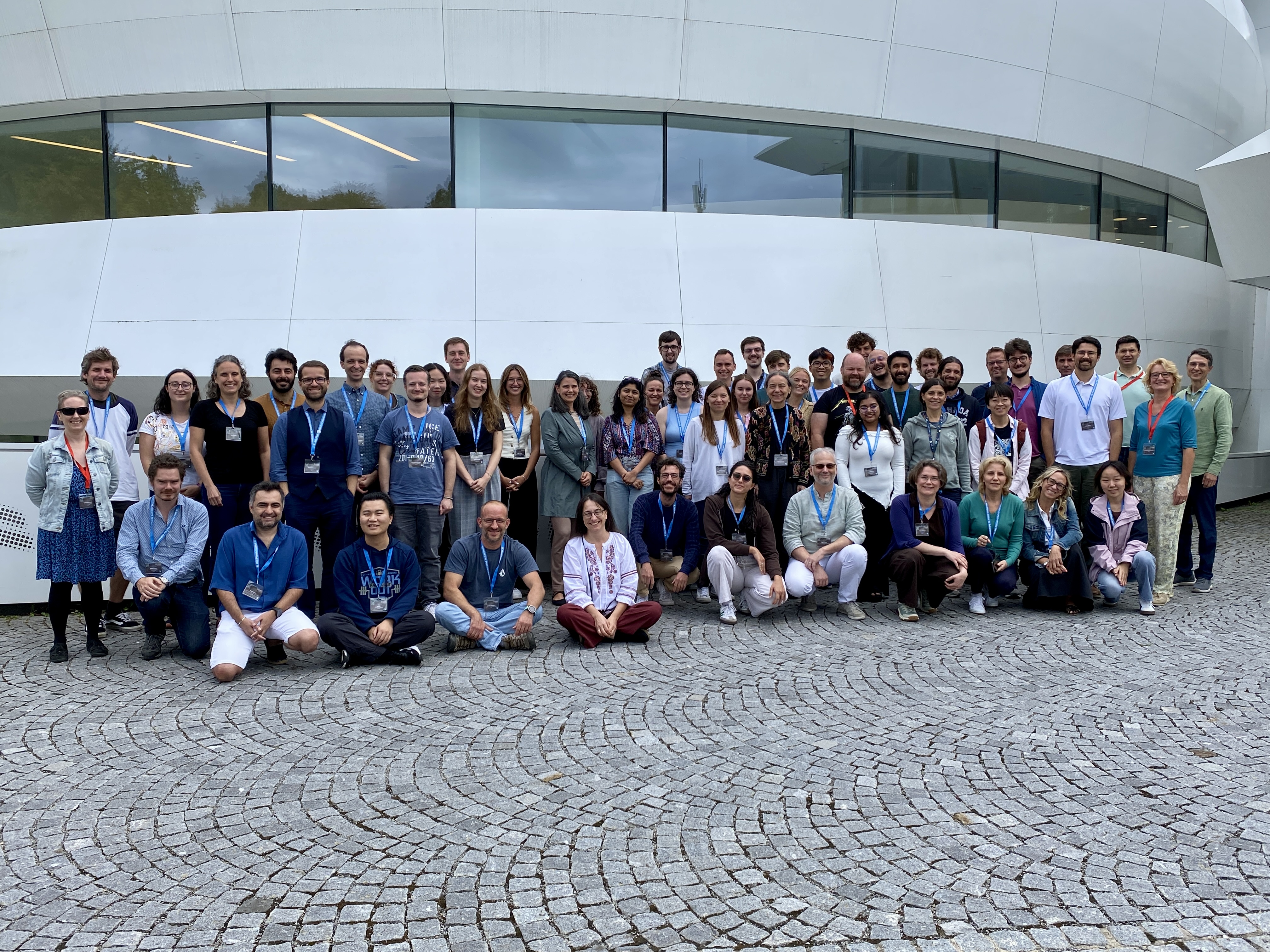
Presentations from the Bridging It WG2/WG3 Meeting held in Heidelberg, Germany, September 2026
Invited Talks
- Exoplanet interiors: the missing link between atmospheric modelling and planet formation - Loreña Acuna-Aguirre (MPIA, Germany)
- Finding new worlds: from exoplanet detection methods to the diversity of planet systems - Domenico Barbato (INAF Padua, Italy)
- Finding it: direct and indirect signals of protoplanets - Valentin Christiaens (CEA Paris-Saclay, France)
- Linking interiors and atmospheres in super-Earths and sub-Neptunes - Caroline Dorn (ETH Zurich, Switzerland)
- Growing it: how planets grow in protoplanetary discs - Anders Johansen (University of Copenhagen/Lund University, Denmark) and Bertram Bitsch (University College Cork, Ireland)
- Debris Discs - Tim Pearce (Trinity College Dublin, Ireland)
- The astrochemical tale of planets - Linda Podio (INAF Arcetri, Italy)
- How to (theoretically) go from discs to planets - Claudia Toci (Universidad de Sevilla, Spain)
- From exoplanet atmospheres to planet formation: an observational perspective - Yapeng Zhang (MPIA, Germany)
Contributed Talks
- Multi-frequency analysis of protoplanetary disks: constraining dust properties across evolutionary classes - Prachi Chavan (Konkoly Observatory, Hungary)
- Characterizing the voltailes and solids around protostars with JWST - Guoyang Chen (Leiden University, Netherlands)
- From cloud to disk: early dust growth and observational biases in young protoplanetary systems - Vardan Elbakyan (Univeristat Duisberg Essen, Germany)
- A new origin for the orbital instabilities of super-Earth systems - Gregory Houlihan (University College Cork, Ireland)
- Late infall onto protoplanetary disks: reshaping our interpretation of substructures - Leon-Alexander Huhn (Heidelberg University, Germany)
- Gas accretion onto giant planets in gravitationally unstable discs: the importance of accretion feedback - Hans Lee (University of Leicester, UK)
- Accreting gas giant exoplanets: predicting high-spectral-resolution observations> - Gabriel-Dominique Marleau (Universität Duisberg Essen, Germany)
- Metallicity and lithium as tracers of planet formation beyond solar mass stars - Ignacio Mendigutia (Centro de Astrobiologia, Spain)
- How giant planet formation scuplts disc composition and shapes subsequent planet formation - Luke Morriss (University of Leeds, UK)
- SCUPLT: Star-cluster and planetary-system dynamics as physically motivated prescriptions for population synthesis, with applications to planetary architectures, free-floating planets and planets in binary stars - Kai Wu (Heidelberg University, Germany)
- Planet formation in close binary systems: connections to free-floating planets - Luyao Zhang (University of Leicester, UK)